
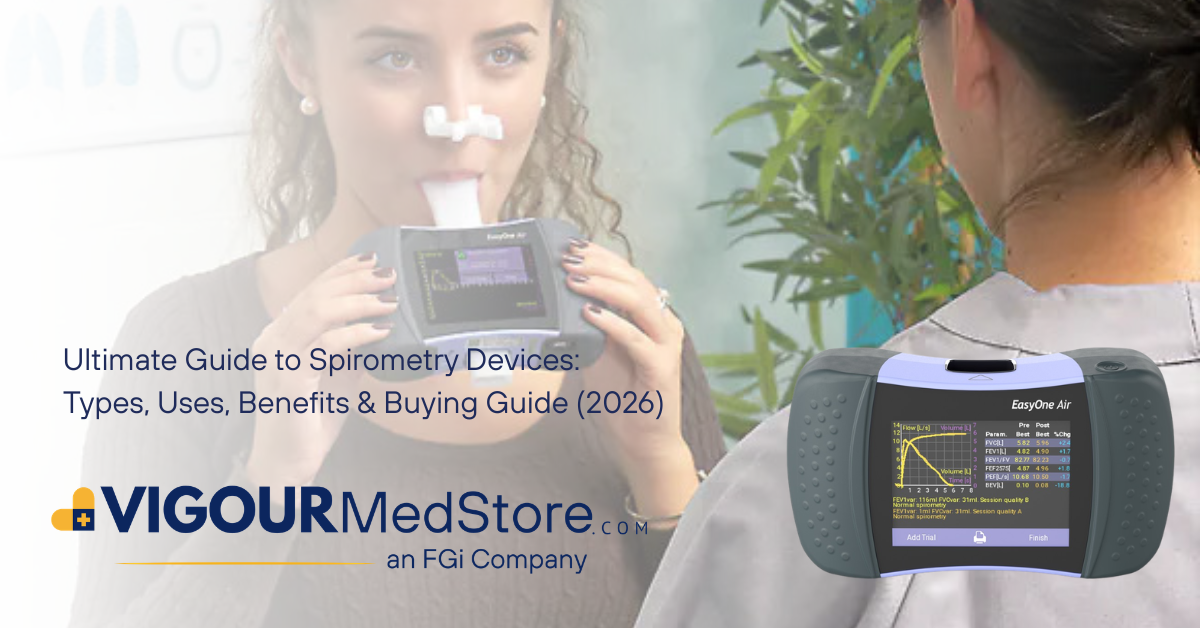
Why Spirometry Devices Matter More Than Ever
Over 334 million people worldwide live with asthma, and more than 65 million suffer from COPD. Yet, many go undiagnosed because they never take a pulmonary function test. A spirometry device changes that. Whether you are a clinician, a patient managing a chronic condition, or someone buying a home spirometer for preventive monitoring, understanding how these devices work, and which one fits your needs directly affects the quality of your respiratory care.
This guide covers everything: what spirometry is, how a spirometer measures your lung function, the differences between device types, what the test results actually mean, and what to look for when purchasing in 2026.
What Is a Spirometry Device And How Does It Work?
A spirometry device is a medical-grade instrument that quantifies lung airflow by measuring either the volume of air displaced or the velocity of airflow through a sensor during a breathing maneuver. The device converts the physical measurement into diagnostic data, FEV₁, FVC, PEF, and more - that is displayed on a screen, printed, or synced to software.
Key spirometry measurements:
| Metric | What It Measures | Clinical Significance |
| FEV₁ (Forced Expiratory Volume in 1 sec) | Air exhaled in the first second of a forced breath | Primary marker for airway obstruction |
| FVC (Forced Vital Capacity) | Total air exhaled in one forced breath | Detects restrictive lung disease |
| FEV₁/FVC Ratio | Ratio of the two above | Distinguishes obstructive from restrictive disorders |
| PEF (Peak Expiratory Flow) | Maximum flow rate during exhalation | Used for asthma monitoring at home |
| MVV (Maximum Voluntary Ventilation) | Max air moved in 12 seconds | Assesses respiratory muscle strength |
A normal FEV₁/FVC ratio sits above 0.70. A ratio below 0.70 confirms airflow obstruction consistent with COPD under GOLD guidelines. The same guidelines place spirometry at the core of every COPD diagnosis.
Step-by-step process of how the measurement is conducted:
- The patient sits upright and applies a nose clip to prevent air leakage.
- The patient breathes normally for a few cycles to establish a baseline.
- On instruction, the patient inhales as deeply as possible.
- The patient then exhales as fast and as completely as possible into the mouthpiece.
- The sensor captures the airflow curve, and the device calculates all spirometric indices.
- The test is repeated at least 3 times; the best 2 reproducible values are used.
Two Core Sensor Technologies Drive Every Spirometer Machine:
Flow-based sensors (most common in modern digital spirometers) measure airflow velocity using a pneumotachograph or turbine. They are compact, accurate, and found in most handheld and portable devices.
Volume-based sensors (used in older water-sealed or bellows spirometers) measure the physical displacement of air. They remain in some clinical labs but are largely replaced by flow-type devices due to calibration requirements.
Types of Spirometry Devices: A Clear Comparison
Not every spirometer machine serves the same purpose. Choosing the wrong type results in inaccurate results, poor compliance, or wasted money. Here is how the main categories differ — and who needs each one.
1. Desktop / Tabletop Spirometer (Clinical Standard)
The majority of hospital pulmonology labs and physician offices use desktop spirometers. They connect to a PC, print reports, and perform pulmonary function tests, including bronchodilator reversibility, MVV, and diffusing capacity tests.
- Best for: Pulmonologists, respiratory therapists, hospital-based diagnosis
- Key advantage: Full ATS/ERS-compliant protocol support, EHR integration
- Example specs: 7-inch touchscreen, embedded printer, optional oximetry
- Limitation: Not portable; requires a trained technician

Shop Easy on-PC Spirometry System
2. Handheld / Portable Spirometer
Portable spirometers fit in a coat pocket and connect via Bluetooth to smartphones or tablets. They run the core FEV₁/FVC/PEF test and store results in a mobile app. Clinicians use them for point-of-care screening; patients use them for home monitoring.
- Best for: Primary care offices, occupational health screenings, home COPD and asthma management
- Key advantage: Compact, wireless, low cost, real-time cloud sync
- Example connection: Bluetooth BLE to iOS/Android + Windows/Mac via USB
- Limitation: Fewer test modes than desktop units; requires a consistent technique from the patient
Handheld models are the fastest-growing segment, projected to grow at a 7.71% CAGR through 2034, driven by employer screenings, telehealth programs, and reimbursement for RPM (remote patient monitoring).

Shop NDD EasyOne Air Spirometer - Portable Spirometry for Clinics & Hospitals
3. Incentive Spirometer (Rehabilitation Device)
An incentive spirometer is not a diagnostic device — it is a respiratory therapy tool. It coaches patients to take slow, sustained deep breaths after surgery, pneumonia, or a lung illness. The device provides visual feedback (a rising ball or piston) to motivate effort, helping expand the alveoli and clear airways.
- Best for: Post-surgical recovery (especially chest and abdominal surgery), lung illness rehab
- Key advantage: Simple, low-cost, no calibration needed, safe for home use
- Capacity range: Typically 1,000 ml to 4,000 ml
- Limitation: Does not generate diagnostic data; does not replace a pulmonary function test
4. Peak Flow Meter
A peak flow meter is a simpler, lower-cost device that measures only PEF — the maximum speed of exhalation. Asthma patients use them daily to track airway variability at home. They do not replace full spirometry but serve as a reliable early-warning tool between clinical visits.
- Best for: Daily asthma self-management at home
- Key advantage: Extremely low cost (~$10–$30), no training required
- Limitation: Single metric only; cannot diagnose COPD or distinguish restriction from obstruction
5. Smart / Connected Spirometer
Smart spirometers embed cellular or Bluetooth connectivity into a compact device, syncing FEV₁ and FEV₁/FVC data directly to a provider's dashboard. Platforms like NuvoAir and Aluna combine device hardware with an AI-powered app that tracks trends, flags exacerbations, and integrates symptom diaries and air quality data.
- Best for: Chronic disease management programs, telehealth, RPM platforms
- Key advantage: Automated provider alerts, high patient engagement, and eliminates paper logs.
-
Clinical evidence: Studies show 77% of COPD patients transmit FEV₁ readings on at least 70% of monitored days using smart spirometers, enabling algorithmic alerts that reduce rehospitalizations.

Buy Now - MIR-911006 Minispir Spirometer
What Conditions Does a Spirometry Test Diagnose?
A spirometry test does not just confirm asthma or COPD — it quantifies the severity, guides treatment decisions, and tracks disease progression over time.
Conditions where spirometry is the first-line diagnostic test:
- COPD — GOLD guidelines require a post-bronchodilator FEV₁/FVC < 0.70 to confirm the diagnosis. COPD accounts for 38.10% of total spirometer use globally because payers condition inhaler coverage on documented lung function.
- Asthma — Spirometry reveals reversible airflow obstruction; a ≥12% and 200 ml improvement in FEV₁ post-bronchodilator confirms reversibility.
- Pulmonary fibrosis — Reduced FVC with a preserved FEV₁/FVC ratio signals restrictive disease.
- Occupational lung disease — Mining, ship-building, and industrial workers undergo annual spirometry as silica and asbestos standards tighten across OSHA regulations.
- Pre-surgical assessment — Surgeons use spirometry to evaluate respiratory reserve before thoracic or abdominal procedures.
Benefits of Spirometry: Why Early Testing Changes Outcomes
Spirometry benefits extend beyond diagnosis — the test enables earlier intervention, better medication titration, and a measurable reduction in hospitalizations. Research from remote monitoring programs shows that patients who track FEV₁ at home have fewer emergency visits than those who rely solely on clinic visits.
Key spirometry benefits, organized by stakeholder:
For patients:
- Identifies airway disease 5–10 years before symptoms become severe
- Tracks response to bronchodilators, corticosteroids, and biologic therapy
- Reduces anxiety by replacing subjective "I feel worse" with objective data
- Enables home self-management between clinical appointments
For clinicians:
- Confirms or rules out obstructive vs. restrictive patterns with a single test
- Provides a documented baseline for insurance and prior authorization
- Integrates with EHR systems for trend visualization
- Supports occupational medicine fitness-for-duty determinations
For health systems:
- Remote spirometry reduces emergency department visits among patients with moderate-to-severe asthma.
- Post-discharge spirometry bundles lower 30-day COPD readmission rates.
- Telehealth-integrated spirometry cuts patient travel CO₂ footprint.
How to Perform a Spirometry Test: Step-by-Step Instructions
Accurate results depend as much on patient technique as device quality. Follow these ATS/ERS-compliant steps for a valid test.
Before the test:
- Avoid bronchodilators for 4–6 hours (short-acting) or 12 hours (long-acting) unless specifically testing post-bronchodilator response.
- Do not smoke for at least 4 hours before testing.
- Wear loose, comfortable clothing that does not restrict chest movement.
- Rest for 15 minutes before starting.
During the test:
- Sit upright in a chair with feet flat on the floor
- Apply the nose clip firmly
- Create a tight lip seal around the mouthpiece, no air leaks
- Inhale maximally and completely
- Blast the air out as fast and as forcefully as possible
- Continue exhaling until your lungs are empty (minimum 6 seconds for adults)
- Rest for 60 seconds, then repeat - a minimum of 3 acceptable maneuvers is required
Quality indicators for a valid test:
- The two best FVC values must agree within 150 ml
- No coughing, hesitation, or early termination
- Smooth, continuous exhalation curve with no back-extrapolated volume > 5% of FVC
Spirometry Device Buying Guide: Factors to Evaluate Before You Buy
The right lung function test machine depends on where it will be used, who operates it, and what data you need. Use these criteria to match device specifications to your actual use case.
1. Intended Use: Clinical vs. Home
Clinical devices (tabletop and PC-based) require full protocol support, EHR compatibility, and ATS/ERS compliance certification. Home devices need simplicity - Bluetooth app sync, guided breathing prompts, and clear trend graphs. Buying a clinical device for home use is a waste of money. It generates confusion. Buying a home device for a pulmonology lab generates unreliable data.
2. Sensor Technology and Accuracy
Flow-based pneumotachograph sensors deliver the highest accuracy and require the least maintenance. Turbine-based sensors are durable and cost-effective but require periodic calibration checks. Look for devices explicitly meeting ATS/ERS 2019 spirometry standards — any serious device will state this in its specification sheet.
3. Connectivity and Software
If you need to track trends over time, the device must connect to the software. Evaluate:
- Bluetooth BLE compatibility with iOS, Android, Windows, and Mac
- EHR integration capabilities (HL7, FHIR)
- Cloud dashboard availability for remote provider access
- Data export in PDF or CSV formats
4. Calibration Requirements
All spirometers require periodic calibration with a 3-liter calibration syringe to maintain accuracy. Pneumotachograph sensors need calibration before each testing session in high-volume labs. Turbine-based devices may need calibration only weekly or monthly. Factor in ongoing calibration time and supply costs when calculating your total cost of ownership.
5. Patient Population: Adults vs. Pediatric
If you test children, confirm the device supports pediatric reference equations and offers an animated or gamified coaching interface, both significantly improve test effort and result quality in patients under 12.
6. Portability Needs
For point-of-care screenings in occupational health settings, emergency triage, or home visits, choose a handheld device. For in-lab printing, a tabletop unit with a built-in 7-inch touchscreen and an embedded printer eliminates the need for a separate PC.
Conclusion
Respiratory disease does not wait, and neither should diagnosis. A spirometry device turns a five-minute breathing test into actionable data that clinicians and patients use to catch airway disease early, adjust treatment, and prevent avoidable hospitalizations.
The right device depends on one thing: how you plan to use it. A primary care practice needs ATS/ERS-compliant desktop equipment with EHR integration. A COPD patient managing their condition at home needs a Bluetooth handheld that syncs FEV₁ trends to their care team.
Match the device to the use case, verify FDA 510(k) clearance, and confirm ATS/ERS compliance before you buy. Those three steps eliminate 90% of poor purchasing decisions.
Browse our full range of spirometry devices - from handheld home monitors to clinical-grade pulmonary function test equipment - and find the right fit for your respiratory care needs.
Have Questions In Mind? Read Our Important FAQs
What is a spirometry device used for?
A spirometry device measures lung function by recording how much air you can inhale and exhale, and how fast. Clinicians use it to diagnose and monitor conditions like COPD, asthma, and pulmonary fibrosis. Patients use home versions to track daily lung health between clinical visits.
What is the difference between a spirometer and an incentive spirometer?
A diagnostic spirometer measures and records lung function metrics (FEV₁, FVC, PEF) to diagnose respiratory disease. An incentive spirometer is a rehabilitation device that guides deep breathing after surgery or illness - it provides visual feedback to improve breathing effort but does not generate diagnostic data.
Can I use a spirometer at home?
Yes. Handheld and smart spirometers designed for home use are available for $300–$1,500. They connect via Bluetooth to smartphone apps and sync results to your care team. Home spirometry is now reimbursable under CMS remote patient monitoring codes, making it accessible through many healthcare programs.
What is a normal result on a pulmonary function test device?
A normal FEV₁/FVC ratio is above 0.70. FEV₁ should be 80% or more of the predicted value for your age, height, gender, and ethnicity. Results below these thresholds suggest airway obstruction (COPD, asthma) or restriction (pulmonary fibrosis). Always interpret results with a clinician.
How accurate are portable spirometers compared to clinical ones?
Portable spirometers that meet ATS/ERS 2019 accuracy standards perform comparably to clinical-grade devices for FEV₁ and FVC measurements. A 2023 Koneksa clinical trial compared home mobile spirometry with in-clinic results in patients with moderate asthma and found clinically acceptable agreement for standard monitoring purposes.
What does FEV₁ measure on a lung function test machine?
FEV₁ stands for Forced Expiratory Volume in one second - the amount of air a person can forcefully exhale in the first second of a maximal exhalation. It is the single most important metric in spirometry. A low FEV₁ relative to predicted values indicates airway obstruction, and tracking FEV₁ over time shows whether a disease is progressing or responding to treatment.
How often should someone with COPD use a spirometer?
GOLD guidelines recommend annual spirometry in clinical settings to stage COPD severity and adjust treatment. Patients enrolled in remote monitoring programs typically perform home spirometry 3–7 times per week. Studies show that 77% of COPD patients on monitored programs transmit FEV₁ data on at least 70% of programmed days.
What features should I look for when buying a spirometer machine?
Prioritize ATS/ERS compliance certification, Bluetooth or USB connectivity, compatibility with your EHR or mobile platform, and calibration requirements. For home use, add ease of use and guided breathing prompts to that list. For pediatric use, confirm that the device supports age-adjusted reference equations and animated coaching.
Is a spirometry test painful or risky?
No. Spirometry is a non-invasive breathing test with minimal risk. Some patients feel light-headed or fatigued briefly after the forced exhalation maneuver. Patients with recent eye or chest surgery or active hemoptysis should consult their physician before testing. The test itself causes no pain.
Which brands make the most reliable spirometry devices for the U.S. market?
MIR, ndd Medical Technologies, Vitalograph, Vyaire Medical, and MGC Diagnostics are the leading clinical-grade manufacturers with U.S. market presence. For home and RPM use, NuvoAir and Aluna combine device hardware with software platforms optimized for chronic disease management. Always confirm that the device holds FDA 510(k) clearance for the U.S. market.
Shop all spirometry devices →


