


Description
What Is the Span America F500S and Who Is It For?
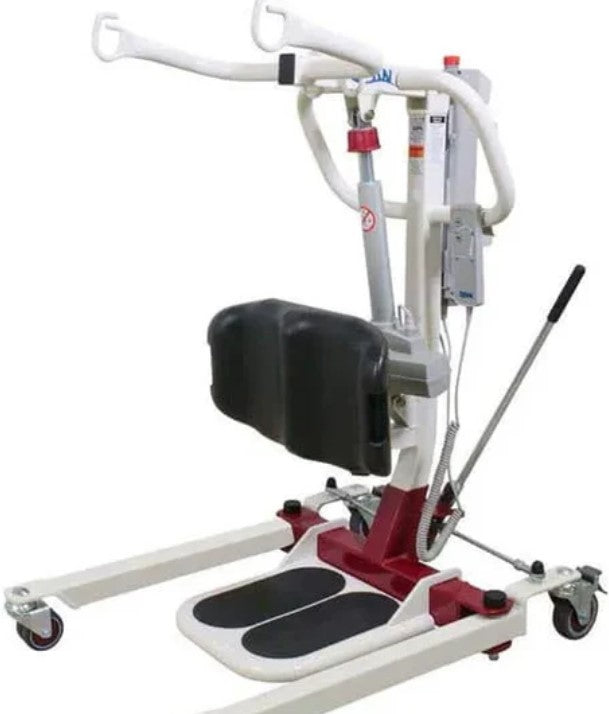
The F500S is an electric stand assist lift designed for patients who retain partial weight-bearing ability in at least one leg. It does not replace a full-body sling lift. Instead, it actively supports the standing movement-reducing caregiver effort while encouraging the patient to engage their own muscle strength during transfers.
Specifically, the F500S suits:
- Elderly individuals who can bear weight but lack the strength or balance to stand unassisted
- Stroke recovery patients managing one-sided weakness (hemiplegia) during early rehabilitation
- Parkinson's patients who need a stable, controlled standing aid that compensates for rigidity and tremor
- Post-surgery patients (hip or knee replacement) returning to independent mobility
- Bariatric patients up to 500 lbs requiring a reinforced transfer solution
Patients who cannot bear any weight on either leg need a full passive boom lift, such as the Span America F500P, instead of the F500S.
F500S Technical Specification
Span America F500S — technical specifications
Powered sit to stand patient lift · Model: F500S
| Feature | Specification |
|---|---|
| Capacity & power | |
| Weight capacity | 500 lbs (227 kg) |
| Power source | Rechargeable battery (quick-release) |
| Battery display | Backlit LCD + audible low-battery alert |
| Patient interface | |
| Knee pad | Contoured, 3-position height adjustment |
| Footplate | Wide, non-slip surface — fixed during transfer |
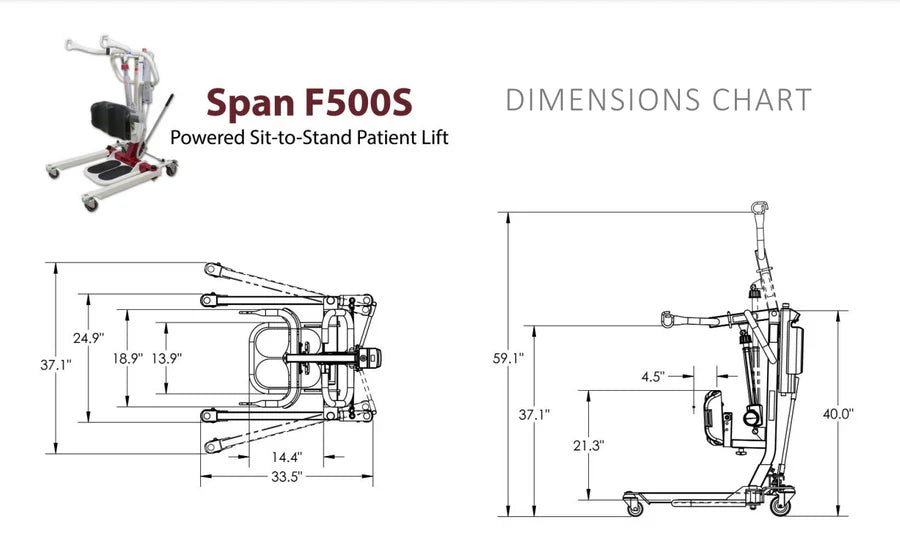
| Base width | Manually adjustable with locking lever |
| Underbed clearance | Yes — fits most low beds |
| Controls & safety | |
| Controls | 2-button pendant + backup control unit |
| Emergency feature | Manual emergency lowering system |
| Safety | Overload protection — visual & audible alert, halts lift |
| Certifications | |
| Standards met |
ISO 10535 IEC/EN 60601-1 ANSI/AAMI CAN/CSA-C22.2 SGS Safety Mark
|
| Warranty | |
| Frame warranty | 3 years |
| Electronics warranty | 2 years |
| Battery warranty | 1 year |
| Shipping | |
| US shipping | Free — 48 contiguous states |
How the F500S Powered Sit-to-Stand Lift Works
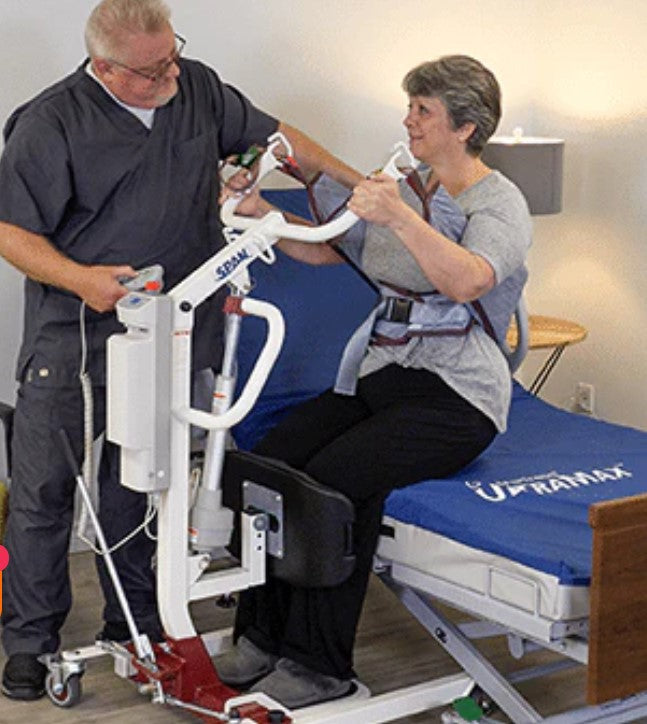
The F500S uses an electrically driven lifting arm that raises the patient from a seated position to standing in a smooth, controlled arc. The caregiver positions the device in front of the patient, adjusts the knee pad height, and activates the two-button pendant. The motor does the lifting-the caregiver guides and steadies.
Follow these steps for a safe transfer:
- Position the F500S directly in front of the seated patient, base spread to match the chair width
- Lock the rear casters to prevent movement during entry
- Guide the patient's feet onto the non-slip footplate
- Adjust the contoured knee pad to the patient's height (3 settings)
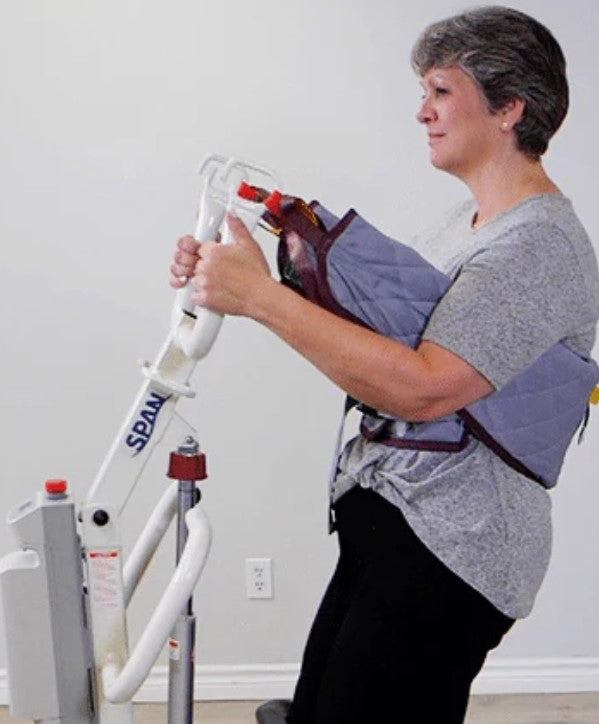
- Instruct the patient to grip the handles and lean slightly forward
- Press the lift button on the pendant-the motor raises the patient to standing
- Once standing, unlock casters and guide the patient to the destination surface
- Press the lower button to ease the patient into the new seated position
The backup control unit handles operation independently if the pendant is ever lost or damaged. Manual emergency lowering activates instantly in any power interruption.
F500S vs Full Body Lift: Which Do You Need?
Choosing the wrong lift wastes money and creates safety risk. Use this comparison to identify the correct device.
F500S sit to stand vs full body lift — which do you need?
Span America F500S · compared against full-body passive lifts (e.g. Span F500P)
| Criteria |
Span America F500S Sit to stand lift
|
Full body lift e.g. Span F500P
|
|---|---|---|
| Patient weight-bearing | Partial — at least one leg | None required |
| Patient cooperation | Yes — must hold handles & follow instructions | Not required |
| Transfer type | Bed, chair, commode (upright) | Full supine to seated transfers |
| Caregiver effort | Minimal — motor assists | Minimal — sling supports fully |
| Space required | Compact — fits tight rooms | Requires more floor clearance |
| Best for |
Parkinson's Stroke Post-surgery Elderly
|
Fully immobile Non-weight-bearing
|
| Price range | Lower | Higher |
If the patient cannot bear weight on either leg, cannot grip handles, or cannot follow verbal instructions — the F500S is not the correct device. Consult a physical therapist to confirm weight-bearing status before purchase.
Why Caregivers Choose the F500S: The Caregiver Back Injury
Problem
Caregiver back injury is the leading occupational hazard in
home care and nursing facilities. Manual patient lifting generates spinal compressive forces that exceed safe limits even on the lightest patients. The F500S removes this risk by replacing manual effort with motorized lifting.
Key ergonomic advantages for caregivers:
- No manual lifting-the motor handles all vertical force; the caregiver only guides
- One-person operation-most transfers are completed without a second helper
- Compact base-maneuvers through standard doorways and tight bathroom spaces
- Adjustable width-the base spreads to accommodate chairs, commodes, and wheelchairs without repositioning the patient.
Facilities using powered stand-assist lifts report measurable reductions in caregiver strain, lost workdays, and patient fall incidents during transfers.
Using the F500S for Specific Patient Conditions
Sit to Stand Lift for Parkinson's Patients
Parkinson's disease causes rigidity, bradykinesia (slowed
movement), and postural instability-all of which make independent standing dangerous. The F500S addresses these challenges directly. Its slow, electrically driven rise gives patients time to activate their motor response without rushing. The contoured knee pad stabilizes the legs throughout the lift, reducing the risk of sudden buckling. The non-slip footplate prevents foot slippage—a common hazard for patients with a shuffling gait. Parkinson's patients benefit most from the F500S when they still bear partial weight and respond to verbal cues.
Sit to Stand Lift for Stroke Recovery
Stroke-related hemiplegia often leaves one side of the body
stronger than the other. The F500S accommodates this asymmetry. The patient stands using their stronger leg while the lift provides lateral stability through the knee pad and handlebar. This controlled loading promotes neuromuscular re-engagement on the affected side-a goal that occupational therapists and physical therapists often prioritize in home rehabilitation programs. Caregivers caring for stroke survivors at home use the F500S to complete bed-to-chair and chair-to-commode transfers without requiring a second person.
Motorized Patient Lift for Home Care
Home care presents specific constraints: narrow hallways,
low beds, tight bathrooms, and a single caregiver. The F500S handles all of these. Its underbed clearance feature works with most low-profile beds. The narrow base footprint-when closed-fits through standard 28-inch doorways. The rechargeable battery charges in place with the included plug-in charger,
eliminating the need for a separate docking station. For families managing a 500 lb patient at home without institutional support, the F500S is one of the few motorized patient lifts for home care that combines this capacity with genuine maneuverability.
Sit to Stand Lift for Bed to Chair Transfer: Step-by-Step
The bed-to-chair transfer is the most common daily transfer task for home caregivers. The F500S handles it in under two minutes.
1.Bring the patient to a sitting position at the edge of the bed, feet flat on the floor
2.Roll the F500S to the bed edge, widen the base to straddle the patient's legs
3.Lock the rear casters, position the footplate under the patient's feet
4.Set the knee pad to the correct height and secure knee contact
5.Instruct the patient to lean forward and grip both handles
6.Press lift-patient rises to standing
7.Unlock casters, pivot, and guide the patient to the chair
8.Lower the patient gently into the seat
The same process applies to chair-to-commode and commode-to-wheelchair transfers with no equipment change.
Sit to Stand Lift with Adjustable Knee Pad: Why It Matters
The F500S includes a contoured knee pad with three height
positions. This matters because patient height and leg length vary
significantly-a one-size-fits-all pad creates shear force at the knee during lifting, which is both uncomfortable and unsafe. The three-position adjustment allows the caregiver to set the pad precisely at mid-thigh, ensuring:
- Even load distribution across both knees
- Stable lateral support throughout the lift arc
- Reduction of pressure points for patients with fragile skin or edema
Set the knee pad before every transfer, not once during
setup. Patient posture shifts between sessions, and a mis-set pad increases fall risk.
Have Questions in Mind? Read Our Important FAQs
What is the Span America F500S powered sit to stand patient lift?
The Span America F500S is an electric stand assist lift that transfers partially weight-bearing patients from a seated to a standing position. It holds up to 500 lbs, operates on a rechargeable battery, and supports transfers between a bed, chair, wheelchair, and commode. It is certified to ISO 10535 and ships free within the 48 contiguous US states.
Who should use the F500S-and who should not?
The F500S suits patients who can bear weight on at least one leg, grip the handles, and respond to basic instructions. It fits elderly patients, those recovering from stroke, Parkinson's patients with partial mobility, and post-surgery patients. It is not appropriate for fully non-weight-bearing patients-those individuals require a full-body passive lift.
Can I use the F500S at home with one caregiver?
Yes. The F500S is specifically designed for single-caregiver home care. The motor handles all vertical lifting force, so the caregiver only guides movement. Its compact base clears standard doorways and low beds. Charging requires only the included plug-in charger-no docking station needed. However, two caregivers may be needed if the patient is bariatric, combative, or has significant cognitive impairment.
Is the F500S a good sit to stand lift for Parkinson's patients?
Yes, when the patient still bears partial weight. Parkinson 's-related rigidity and slow movement make the F500S's motorized, controlled lift speed an advantage over manual methods. The non-slip footplate prevents foot displacement during shuffling, and the knee pad provides lateral stability against Parkinson's postural instability. Consult a physical therapist before first use to assess weight-bearing status.
Does the F500S work for stroke recovery at home?
Yes. The F500S accommodates hemiplegia (one-sided weakness) by providing bilateral support through the knee pad and handlebar while the patient bears weight primarily on the stronger leg. Occupational therapists commonly recommend this class of stand-assist lift for stroke patients transitioning from inpatient rehab to home care. Confirm partial weight-bearing ability with a therapist before purchase.
What is the weight capacity of the F500S?
The F500S has a safe working load of 500 lbs (227 kg). The lift includes overload protection-if the load exceeds this limit, the motor stops and a visual and audible alert activates. This prevents mechanical stress and protects both patient and caregiver.
How does the F500S handle a power failure during transfer?
The F500S includes a manual emergency lowering system. If power interrupts mid-lift, the caregiver activates this manual control to lower the patient safely to a seated position. The backup control unit on the device body also operates the lift independently if the handheld pendant is lost or damaged.
Is the F500S covered by Medicare or insurance?
Medicare coverage for sit-to-stand lifts depends on the specific plan, the patient's diagnosis, and the prescribing physician's documentation. The F500S meets ISO 10535 certification requirements, which satisfy many payer compliance requirements. Contact your insurance provider with the product's HCPCS code and a letter of medical necessity from your physician to determine coverage eligibility. Vigour Med Store cannot submit insurance claims on your behalf.
How does the sit to stand lift with adjustable knee pad differ from fixed-pad models?
A fixed knee pad fits one patient's height. The F500S offers three height settings, accommodating patients from approximately 5'0" to 6'2". A correctly adjusted pad height distributes load evenly across the knee joint, prevents skin shear, and improves stability during the lift arc. Patients with edema, post-surgical swelling, or fragile skin particularly benefit from height-adjusted support over a fixed pad.
What does a stand assist device for partially weight-bearing patients actually do?
A stand-assist device for partially weight-bearing patients provides powered vertical support during the transition from sitting to standing, filling the gap when the patient cannot fully self-propel but does not need complete external support. The device activates leg muscle engagement, maintains caregiver safety by eliminating manual lifting, and enables transfers across multiple surfaces without changing equipment.


